
Bioavailable Magnesium vs Magnesium Oxide: What Actually Works
Table of Contents
- Why Bioavailability Matters: What the Research Actually Shows
- Magnesium Oxide vs Magnesium Citrate: The Direct Comparison
- Magnesium Glycinate vs Magnesium Oxide: Which Absorbs Better
- Most Bioavailable Form of Magnesium and How to Spot It
- Reading Elemental Magnesium on Supplement Labels
- When Magnesium Oxide Makes Sense (And When It Doesn't)
- Choosing the Right Magnesium for Your Goals and Tolerance
- Frequently Asked Questions
Last Updated: October 12, 2026
Why Bioavailability Matters: What the Research Actually Shows
Bioavailability is how much of a supplement your body actually absorbs and uses. Understanding bioavailable magnesium vs magnesium oxide is essential, since not all magnesium supplements are equal, some dissolve easily in your digestive system, while others pass through largely unused.
But "bioavailability" isn't one number. It's a family of measurements, and they don't always agree.
Four different things people call "bioavailability"
- Solubility, how well the compound dissolves in water or stomach acid. A lab property, not a biological outcome; a form can be highly soluble and still poorly absorbed.
- Absorption, how much magnesium crosses from your gut into your bloodstream, often measured with a tracer or by tracking how much disappears from a known dose.
- Blood or urine levels, how much shows up in serum or what you excrete. Serum magnesium is tightly regulated, so it can look normal even when tissues run low; urine tells you about excretion, not retention.
- Clinical outcomes, whether the supplement changes something you care about: sleep quality, muscle cramps, bowel movements, blood pressure. This matters most and is reported least.
When you see "form X is 4x more bioavailable than form Y," ask which of those four the study used. A solubility comparison and a clinical-outcome trial can reach very different conclusions about the same two products.
Why the numbers vary so much between studies
Even when two studies measure the same thing, they often disagree. Common reasons:
- Dose, absorption efficiency falls as the dose rises, so 100 mg and 400 mg tests aren't comparable.
- Formulation, the same chemical form in a capsule, tablet with binders, or powder can behave differently.
- Meal timing, taking magnesium with food slows transit and can change absorption.
- Baseline magnesium status, someone depleted absorbs a larger fraction than someone replete, which alone can swing reported numbers substantially.
- The measurement itself, solubility, absorption, serum, urine, and outcomes are not interchangeable.
What this means for comparing oxide to other forms
Magnesium oxide is consistently less soluble and less absorbable than organic forms like citrate and glycinate across most study designs, that part is well established. The exact multiplier is not: oxide absorption is cited anywhere from roughly 4% to double digits, and organic forms from the mid-teens to around 40%.
The practical takeaway: oxide is genuinely the weaker absorber, but don't anchor on a specific ratio. Anchor on the mechanism (poor solubility in the gut) and on your goal (does the unabsorbed portion do something useful for you?).
Magnesium Oxide vs Magnesium Citrate: The Direct Comparison
Magnesium oxide is the cheapest form available and the least soluble in water and stomach acid, so your digestive system absorbs very little, studies generally show 4-8%, meaning most of what you ingest is excreted.
Magnesium citrate bonds magnesium to citric acid, making it far more water-soluble and readily absorbed. Absorption typically falls between 16-25%, roughly 3-5 times more bioavailable than oxide.
The trade-off is cost and side effects. For sleep or muscle recovery, that side effect can be problematic.
Oxide, despite poor absorption, has legitimate uses: because it passes through largely unabsorbed, it acts as a natural laxative.
The real lesson: match the form to your goal. Don't buy oxide for general health support just because it's cheap.
Magnesium Glycinate vs Magnesium Oxide: Which Absorbs Better
Magnesium glycinate is magnesium bonded to the amino acid glycine. Your body recognizes glycine and actively transports both across your intestinal wall, giving absorption rates of 25-40%, significantly more bioavailable than oxide.
Glycine itself supports sleep quality, nervous system relaxation, and muscle recovery, so you get a synergistic combination rather than magnesium alone.
Compared directly to oxide, glycinate wins on every measure except price: you absorb 3-5 times more magnesium per dose, get the glycine benefits, and avoid digestive effects.
Our MAX PROTECTION - Chill Pill Magnesium Glycinate uses this highly absorbable form specifically because we prioritize what your body can actually use. At $24.99, it's an investment in absorption that pays off in results.

Most Bioavailable Form of Magnesium and How to Spot It
The most bioavailable forms are bonded to organic compounds your body recognizes and actively transports: magnesium glycinate, malate, taurate, and threonate, with absorption rates between 25-40%.
Magnesium citrate and malate are also highly absorbable (16-25%), though citrate's laxative effect limits its use for general health support. The least bioavailable are magnesium oxide and magnesium sulfate (Epsom salt), both under 10%.
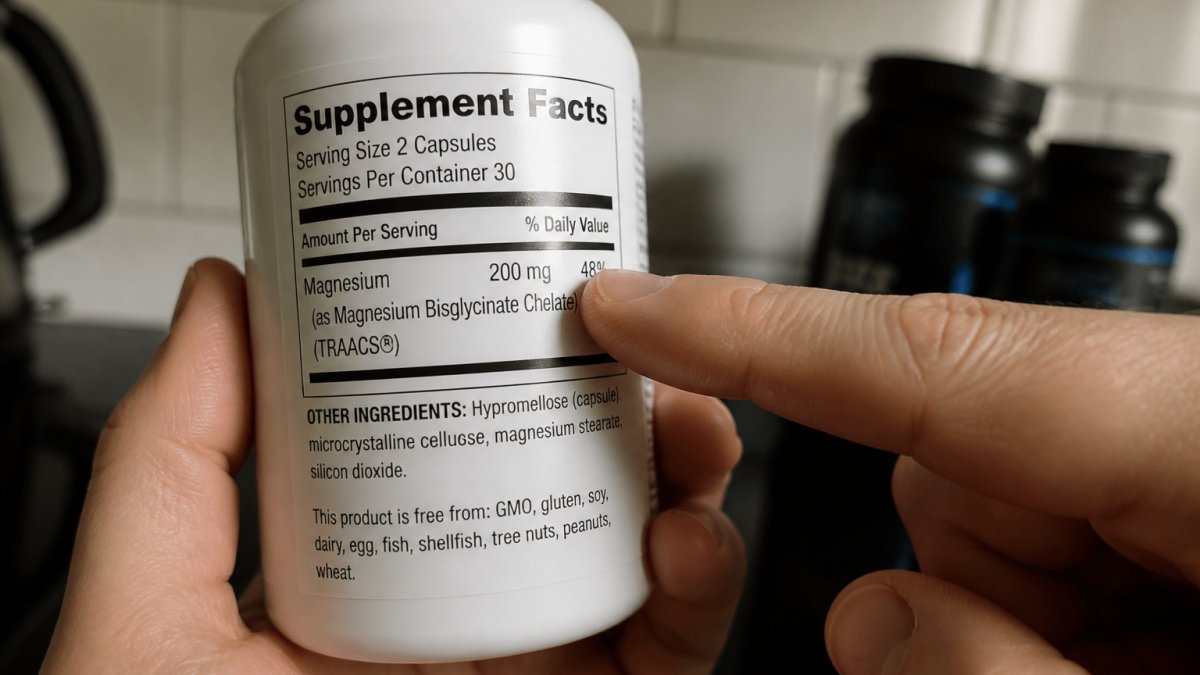
The label should also state "elemental magnesium" with a number in milligrams, the actual amount of pure magnesium your body can use, not the total compound weight.
Reading Elemental Magnesium on Supplement Labels
A magnesium supplement label shows two numbers: the total weight of the compound and the elemental magnesium content.
For example, magnesium oxide at 500 mg total weight contains roughly 300 mg of elemental magnesium; the other 200 mg is oxygen atoms. Magnesium glycinate is different, a 500 mg dose contains roughly 25-30 mg of elemental magnesium, with the rest being the glycine compound.
MAX PROTECTION - Chill Pill Magnesium Glycinate →
To compare supplements fairly:
- Find the elemental magnesium amount (should be clearly labeled)
- Multiply by the absorption rate of that form (oxide ~6%, citrate ~20%, glycinate ~30%)
- This gives you the approximate amount your body will actually use
A 500 mg dose of oxide with 300 mg elemental magnesium, absorbed at 6%, delivers roughly 18 mg. A 500 mg dose of glycinate with 30 mg elemental magnesium, absorbed at 30%, delivers roughly 9 mg. The oxide looks better on paper, but you're actually getting less usable magnesium.
When Magnesium Oxide Makes Sense (And When It Doesn't)
Magnesium oxide gets dismissed as "the cheap one that doesn't absorb." That's half true. Here's the honest version.
The case for oxide
- It carries more elemental magnesium per milligram of compound than almost any other form. Roughly 60% of magnesium oxide's weight is actual magnesium, versus roughly 14% for citrate and low single digits for glycinate. A 400 mg oxide tablet can deliver around 240 mg of elemental magnesium while a 400 mg glycinate capsule delivers only a few dozen milligrams. If you need a large elemental dose in a small pill, oxide is efficient by mass.
- It's inexpensive and widely available. Oxide is the form in most drugstore magnesium shelves and many store-brand products, with the lowest cost per elemental milligram of the common forms.
- It has established, non-supplement roles. It's a recognized over-the-counter ingredient for short-term constipation relief and for heartburn or indigestion (often paired with an antacid). Those uses lean on much of the dose staying in the gut, the "poor absorption" is the mechanism, not a defect.
- It's the form most studied in older research. Much of the historical magnesium literature used oxide because it was the standard. That doesn't make it the best form, but it means there's a long track record.
The case against oxide for general supplementation
If your goal is raising magnesium status for sleep, muscle recovery, cardiovascular support, anxiety, or bone health, oxide is a poor delivery vehicle. It's poorly soluble in the gut, so a large share of the dose never crosses into your bloodstream, you're paying for elemental magnesium your body won't use.
This is where the cost argument flips: a cheap oxide bottle can cost less per pill but more per absorbed milligram than a pricier organic form. Run the elemental-dose math (see the label section above) before assuming the bargain is a bargain.
Medication interactions and when to talk to a clinician
Magnesium supplements, oxide included, can interact with several common medication classes. This is general information, not medical advice; check with a pharmacist or clinician about your specific regimen.
- Certain antibiotics (notably tetracyclines and fluoroquinolones) can bind to magnesium and lose effectiveness if taken too close together; separating doses is often recommended.
- Bisphosphonates for bone health can have their absorption reduced by magnesium taken at the same time.
- Some diuretics and proton-pump inhibitors can affect magnesium balance, so adding a supplement may not be appropriate without guidance.
- Levothyroxine absorption can be reduced when taken with mineral supplements.
Who should be especially cautious
- People with kidney disease or impaired kidney function. Magnesium is cleared by the kidneys, so reduced clearance plus supplementation can lead to dangerously high levels. Do not supplement without clinician oversight.
- Anyone taking multiple medications. The more drugs in the mix, the higher the chance of an interaction.
- People with persistent digestive symptoms. If constipation, diarrhea, or cramping doesn't resolve with reasonable changes, see a clinician rather than escalating the dose.
- Pregnant or breastfeeding individuals. Needs and safe upper limits differ; get individualized guidance.
A simple decision rule
- Goal is constipation relief, short-term: oxide (or citrate) is a reasonable, affordable choice.
- Goal is heartburn or indigestion: oxide in an antacid formulation is a recognized option.
- Goal is raising magnesium status for sleep, recovery, or general health: choose a more absorbable organic form and skip oxide.
- You have kidney disease, take prescription medications, or symptoms won't resolve: talk to a clinician before supplementing at all.
The supplement industry relies on consumers not understanding this distinction, a manufacturer can list a high elemental magnesium number on an oxide product and sell it as a bargain. But the fix isn't to write oxide off entirely. It's to match the form to the goal, read the elemental dose, and know when to ask a professional.
Choosing the Right Magnesium for Your Goals and Tolerance
Your choice depends on three factors: your health goal, your budget, and your digestive sensitivity.
For sleep and relaxation: Magnesium glycinate is the clear choice.
For muscle recovery and athletic performance: Magnesium malate or glycinate both work well.
For constipation relief: Magnesium oxide or citrate, used temporarily. Oxide is cheaper; citrate works faster.
For cardiovascular support: Magnesium taurate is formulated for heart health, as taurine supports cardiac function. Glycinate is also solid for general cardiovascular benefit.
If you have a sensitive stomach: Glycinate is your safest bet, well-tolerated and unlikely to cause digestive disturbance.
If cost is a major factor: Magnesium citrate offers better absorption than oxide at a lower price than glycinate.
The supplement industry counts on confusion.
Frequently Asked Questions
Is magnesium oxide less bioavailable than other forms of magnesium?
Yes. Magnesium oxide is poorly soluble in water and stomach acid, which limits how much your digestive tract can absorb. Studies show bioavailability, the percentage your body actually absorbs, is significantly lower for magnesium oxide compared to organic salts like citrate or glycinate. However, bioavailability measurements reflect lab conditions, not your individual digestion. Factors like stomach acid, food timing, and your own magnesium status affect real-world absorption.
What is the difference between magnesium oxide and magnesium glycinate?
Magnesium glycinate pairs magnesium with the amino acid glycine, making it highly soluble and well-absorbed. It's gentle on the digestive system and often used for relaxation and sleep support. Magnesium oxide is an inorganic salt with much lower solubility and bioavailability. It's cheaper, has higher elemental magnesium content per dose, and is commonly used as a laxative. Choose glycinate if you prioritize absorption and digestive comfort; oxide if cost and constipation relief matter more.
How do I compare elemental magnesium across different supplement labels?
Look for 'elemental magnesium' listed separately from the total compound weight. For example, magnesium oxide may show 500 mg of magnesium oxide but only 300 mg of elemental magnesium. Elemental magnesium is what your body actually uses. Compare this number, not the total compound weight, across products to fairly evaluate dose strength and cost per milligram of actual magnesium you're getting.
Why do some supplements still use magnesium oxide if it absorbs poorly?
Magnesium oxide is inexpensive, shelf-stable, and delivers more elemental magnesium per pill than organic forms. It's also effective as a laxative for constipation relief. Manufacturers use it to keep costs down and dosing convenient. However, if your goal is raising magnesium levels for muscle recovery, nerve function, or general supplementation, more bioavailable forms like glycinate or citrate deliver better absorption and are gentler on digestion, making them worth the higher price for most users.
